REVIEW: Infinite Kung Fu

I love this book. Really, really love it. I love it so much that I don’t think I can explain how much or why without waxing long and lyrical. For those for whom long and lyrical waxing is a turn off here’s my ‘cover quote’ review:
If you took the best elements of every martial arts movie ever made, added an oh so cool splash of blaxpoitation, mixed in a hoard of zombies, and added some of the best art in comic books – you probably still wouldn’t be able to cook up a dish as scintillating to your fanboy palate as Kagen McLeod has created with “Infinite Kung Fu”. Buy it now or tear up your comic book geek membership card forever!
Still too long? How about:
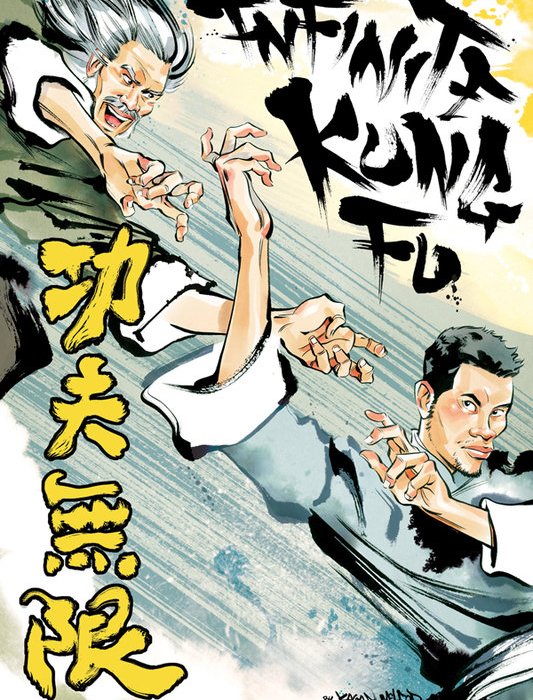
The art is visceral, kinetic, and intensely cinematic. McLeod has, perhaps more than any before, truly translated the power and beauty of the martial arts onto the drawn page. He’s a Grand Master of sequential art.
No?
Hits harder than a ‘Buddha Palm’ to the gonads!
Or for you real ADHDers:
It rules! Buy it!
Now, if you’re still reading this and not already at MK1 hitting Chris up for a copy of this fantastic tome, I’ll assume you like to get right down to the actual factual before parting with your hard earned dollars. You like to get both the nitty and the gritty before making a decision. Ok, I respect that, but don’t say I didn’t warn you!
.
I hate to admit it, but I’m old enough to remember David Carradine’s “Kung Fu” series being on the tele. Well actually, its probably more accurate to say that I have vivid recollections of seeing the oh-so-enticing ads for said series since my Mum had been to teachers college and had become totally militant in enforcing her ideas about bedtimes and not exposing my young mind to anything remotely (in her view) violent or (in my view) cool. Kung Fu came on at exactly my bedtime so the full extent of my viewing was the aforementioned trailers (usually a profound sounding snippet of conversation between the young “grasshopper” and his blind Shaolin Master, followed by some cool action scene of the adult Kwai Chang Caine kicking some bad dude in the head) and if I could manage to reeeeeeally prolong the pre-bedtime ritual putting on of pajamas and brushing of teeth – the first scene and opening credits of the show proper. This would be followed the next day by having to see and hear the endless re-enactments by my friends who all were allowed to watch the whole thing.
In my young mind, Kung Fu became the epitome of Forbidden Coolness and Bad Assery, a conclusion that was finally confirmed when my Uncle assumed baby sitting duties on the nights it was on. Due to his less than rigid adherence to my Mum’s Commandments of TV and Bedtime I was finally able to experience the programme in its fullness. Young Matman was not disappointed.
Although it might seem a bit hokey and slow when viewed all these years later, at the time it was totally unlike anything else on tv. The idea of this mysterious fighting art from China that enabled its proponents to become unbeatable while also gaining hidden wisdom was captivating to my younger (short, skinny, and already a bit nerdy) self.
Fast forward a few years to my 12th birthday when (after years of endless pestering) my Mum finally agreed that I was old enough to watch a Bruce Lee video. It was Fist of Fury (aka the Chinese Connection) and I can remember being as enthralled by the magnetic charisma of Lee as I was amazed by the speed and dynamism of his movements. I watched it twice in a row, fell asleep, woke up and watched it twice more the next day. After that I quickly sought out “The Big Boss”, “Way of the Dragon”, “Game of Death” and “Enter the Dragon”. Having run out of Bruce Lee films to watch I exhausted the Martial Arts section of the local video shop, leading over the years to the discovery of Jackie Chan’s Kung Fu comedy and amazing stunts; the Shaw Brothers films (directed by the great Chang Cheh and Lau Kar-Leung) with exotic titles like “5 Deadly Venoms”. “36th Chamber of Shaolin”; Tsui Hark and his “Once upon a time in China” series; to movies featuring actors like Sammo Hung, Gordon Liu, Jet Li, Donnie Yen; and to mysterious and alluring sounding techniques like the ‘Buddha Palm’, and ‘No Shadow Kick’. The movies had implausible storylines that often relied on outrageous coincidences or launched off on weird tangents, terrible voice dubbing (and/or poorly translated subtitles), and cheap production values – but still had a magnetic pull on me.
I think the source of is that pull is that, at their core, martial arts movies are stories about people achieving the great and the unbelievable through hard work (the literal meaning of Kung Fu), discipline, and self mastery. No radio-active spiders, chemistry set accidents, or powers bestowed by powerful beings from another planet – the Kung Fu hero achieves his power by passing through great trials, making great sacrifices, and exerting great effort. They’re stories that at their heart speak to the power of human potential. You could easily argue that Batman or Daredevil are essentially Kung Fu movie men in tights (which is probably why those 2 are 2 of my my favourite super-heroes…the Kung Fu thing that is, not the tights).
This fascinating voyage through the life of Matman is mainly to point out that I was completely hardwired to either lurve or detest Infinite Kung Fu. if I, as a funny book reading, martial arts movie watching, Bruce Lee imitating fool, am not the target market for this, then it’s hard to think of who is. There have been plenty of crappy comics written/drawn by those with only a passing interest in/knowledge of the genre and if guys like me (believe it or not there are others) don’t buy it (conceptually and financially) then the book it would be hard to imagine that it would find a place in the market. Well, that’s what I thought when I first picked it up anyway. What I found is a book that has much wider appeal than to just the funny book reading, martial arts movie watching, Bruce Lee imitating fools of the world.
It’s obvious from every pencil and brush stroke on every panel of every page of Infinite Kung Fu that Kagen McLeod ‘gets’ what makes the genre work. The book is a 464 love letter to Kung Fu movies that not only references and pays tribute, but joins them in using the classic tropes (plus Moog Joogular: the coolest black man never to appear in a blaxpoitation flick, and the aforementioned zombie hoards) to tell a great story. The book is a tour de force that, perhaps more than any other comic I’ve read, captures the kinetic beauty of martial arts in sequential art (yeah, I know I already said that, but its true and worth repeating).
Although stylistically very different, the art in IKF makes me think of Jeff Smith’s work on Bone in that there’s a lot more happening that you will ever pick up on a casual flick through. Actually if you don’t give yourself some serious time to sit down and really absorb all of the detail you are robbing yourself of much of the coolness. The book is in black and white which isn’t everyone’s cup of tea but to be honest, I think that the addition of colour would actually detract from the experience – like adding colour to Frank Miller’s Sin City.
Storywise, the elements are all there. Grand Masters with mysterious powers, deceitful disciples/evil villains who use forbidden techniques, a young hero who has to overcome adversity and train hard to ultimately conquer, hot Kung Fu babes, magic, zombies, and my favourite – Moog Joogular: the coolest black man never to appear in a blaxpoitation flick. The writing is low key and doesn’t stand out in an Alan Moore sort of way but it fits with the art to create the IKF gestalt of awesomeness.
This really is the most fun I’ve had reading a comic book in a long time (and I have a lot of fun reading comic books) and I can’t wait to see what Kagen McLeod does next (Hopefully it’s something with Moog Joogular: the coolest black man never to appear in a blaxpoitation flick)
Recommended for:
- Anyone who has ever enjoyed a Bruce Lee/Jackie Chan/Shaw Bros/Jet Li/Donnie Yen film.
- Anyone who thinks that Shaft is the epitome of coolness and that ‘Sho Nuff’ was the best character in “the Last Dragon”
- Zombie fans.
- People who like fantastic art.
- Ah, to hell with it – everybody! (though given the amount of entrails and detached body parts that fly across the pages, maybe not the Young and the Squeamish)


 The Matsignal