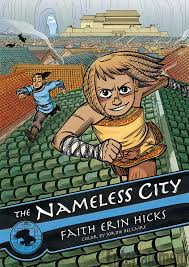
Here’s an interview I did with Faith Erin Hicks in 2016 about her background and specifically her awesome series “The Nameless City”. If you don’t know Faith from her own creator owned titles, you may well know her from her work on the Avatar: the Last Airbender sequel comics. You can find out more about Faith and her work on her website: https://www.faitherinhicks.com/
Kia Ora Faith – thanks heaps for agreeing to do this!
While it’s definitely changing, comics has long been a pretty male dominated field in terms of creators, content, and readership – how did you first become exposed to the medium?
I read comics as a kid. I was big into Tintin and Asterix comics, which are very popular in Canada (less so in the States). I also read newspaper comics, and when the internet finally became a thing, I was big into webcomics.
How did your taste evolve over time in terms of the types of comics you were reading?
I definitely started getting more picky about the kinds of stories I wanted to read. When I was younger I would just read anything in comic form. I remember I had a comic book version of the Bible that I loved. When I hit my late teens/early twenties, I really wanted more mature stories, and I especially wanted stories where girls and women were prominent.
My readers will know because I’ve pointed it out before, but I was quite slow to come to the realization that the comic books I was reading were actually written and drawn by somebody and that there were certain somebodies whose work in enjoyed more than others – at what point did you make that realization and who were some of the creators that stood out to you?
I don’t really remember when I realized there was a person behind the comic book that I was reading. I remember having some knowledge of creators like Lynn Johnson and Bill Watterson. I guess the first creator I really latched on to was Jeff Smith, who created Bone. That was the first narrative comic that I was really into, and I really wanted to draw like him. I even started inking with a brush because Jeff Smith inked with a brush.
When did creating comics become something that you thought you’d like to do yourself?
I started making comics when I was in my late teens, while I was in school. I did a webcomic for fun while I was in college. It was just a hobby, and I never thought I would be a good enough artist to be a professional. I was more interested in animation as a career. (I went to college for animation.)
Did you always draw and write or did one come before the other?
I definitely wrote before I drew. When I was in high school I was huge into prose writing. I had a whole list of ideas that I eventually wanted to turn into novels. I’d always drawn as well, but it was more of the “copy this photo” variety. I didn’t really do cartoon drawings, and I didn’t draw out of my head. I got into that later on, when I started making comics.
At what point did you think you might be able to make a career out of this?
Well, it wasn’t really a choice, initially. I never intended for comics to be my fulltime job, and I remain astonished that I’ve been able to do it for so long. What happened was I was laid off from my job in the Canadian animation industry, and I couldn’t find work anywhere. I had this one freelance job drawing a graphic novel for First Second Books (it was called Brain Camp), and it paid enough money for me to live on for six months. So I decided to work fulltime on this one graphic novel, and at the end of the sixth months, hopefully I could find another job in animation. And that was eight years ago! I managed to get more jobs in comics, and never had to go back to animation. It’s pretty amazing that it worked out. I’m a lot happier in comics than I was in animation.
You started out doing web comics – what are the pros and cons of working on something more episodic like a webcomic vs something more long form like Nameless City?
Working on a GN like Nameless City can be very isolating. It’s just me and my editor working on this giant project, and we had no idea if it would actually resonate with readers. With webcomics you’re sharing the comic as you work on it, so you have a chance to gauge your readers’ responses as the pages are posted online, which can be really cool. Or it can be awful, if the response isn’t what you hoped for. But I honestly prefer the graphic novel format, and I really like working with publishers. When you’re doing a webcomic, it’s usually just you doing everything, including marketing and publishing if you decide you want a collected hardcopy version of your webcomic. When I work with a publisher like First Second, they do all that stuff for me; all the marketing and distribution and promotion. I like that I can just focus on drawing comics and I don’t really have to do anything else.
Moving on to ‘the Nameless City’ (which is awesome – by the way!)…
What was the original idea that sparked the project? How do these things usually coalesce creatively for you– do you start with the characters or the setting or the situation or all of the above?
The Nameless City had a pretty basic beginning: I wanted to write and draw a story about two kids from the opposite side of a complicated political conflict, and I wanted the setting to be “fantasy.” I wasn’t sure what the world would look like, or whether there would be magic, but I knew it wouldn’t be a realistic setting. I wanted to challenge myself as an artist. I’d just drawn two graphic novels with realistic high school settings (Friend with Boys and Nothing Can Possibly Go Wrong), and I was really sick of drawing school lockers. I wanted a setting that was very different.
How would you describe it to someone who has never read the book?
My elevator pitch is: two kids meet in a City that has been conquered repeatedly. One kid is a member of the ruling elite, the other is a street kid orphaned by conflict. They form a combative friendship and end up entangled in a conspiracy and assassination plot. Or I just say it’s kind of like Avatar: The Last Airbender, but without the magical bending.
The ancient China-esque setting is quite different from the more modern day/school settings of some of your other work – what attracted you to that place and time?
I had read a couple of nonfiction books about the Yuan Dynasty, so it was a time period that interested me. By all accounts it was a complicated time of great upheaval, and some of the historical events mirrored the themes of conquest and occupation that I wanted to explore. I also wanted to stay away from European history inspired fantasy which seems to dominate the genre.
You’ve got this intriguing, incredibly realized setting with cool martial arts and free running but at its heart it’s the story of Kai and Rat and how they develop their friendship – is that the crux of the series or will there be other points of view in the coming volumes.
Kai and Rat’s friendship is definitely the backbone of the comic, although there are different themes and points of view that I explore later on. There are characters whose points of view I think are very sympathetic, but they also make bad decisions with terrible consequences.
Despite them coming from opposite sides of the tracks they seem to share their sense of loneliness and not fitting into their respective worlds – is that kind of the point of the story?
I think Rat fits into her world fine, she’s just suffered under the system she’s forced to live under, because she’s seen as less than human by some of the enforcers of that system. Kai, by contrast has been born with a lot of privilege, but he starts to see the injustices that exist in the system that gives him that privilege. So it’s more about these two coming together to hopefully affect the world they live in.
You do a great job of translating the kinetics of the martial arts and free running scenes into static panels – did you have any particular influences in figuring out your approach or is it just something that came naturally?
Haha, nothing about drawing comes naturally to me! I looked a lot of different comic books and stole from the best. Manga like Fullmetal Alchemist or Naruto do action really well, so those were big influences. There are a couple North American artists who do action and running really well; James Harren is great at that kind of stuff.
There’s obviously some Manga influence in your use of speed lines and some of your facial expressions – where does that come from?
My biggest influence is probably Hiromu Arakawa, who wrote and drew Fullmetal Alchemist. I love her. I also really like Naoki Urasawa, although he’s not known for his action.
I found it interesting that you had cover quotes from Bryan Konietzko (co-creator of Avatar: the last Airbender) and Jeff Smith because the setting of Nameless City and the age of the characters reminded me of the former and there were elements of your art and the vibe of the book that kind of reminded me of Bone – were either of those influences?
Yes, both Avatar and Bone were big influences, and I’m thrilled Jeff and Bryan blurbed the book! They’re both my art heroes and it was wonderful they had kind words for me. I initially pitched Nameless City to my publisher by saying that I wanted to do a comic like Bone. It’s still one of my favourite books of all time.
Although there are martial arts scenes in the book (Mura is pretty bad ass!) – Rat and Kai’s skills are more in their parkour style travel through the Nameless city – was it a conscious choice to have the story’s main heroes have strengths other than fighting? Even with Mura – she’s the most skilled martial artist we encounter in the book which goes against the normal gender stereotypes you’d find in a story with this type of setting – were you deliberately playing with expectations there as well?
Yes, absolutely. It was a very deliberate choice for Kai to be bad at fighting, and for him to be kind of repulsed by the violence in his society. I love action and adventure as a genre, but often times I don’t find it to be very thoughtful about how it portrays violence. I wanted to make an action comic, but have the action come out of characters running and jumping as they explored the City, not hand to hand combat. As for gender stereotypes, it’s always my goal to mess with them, because they’re mostly nonsense. Mura is a character I’ve wanted to write for a long time, and I love where her story goes.
There seems to be potential for things to move in a more fantasy direction as we find out more about the mysterious Northern People/First Builders – will we see more of these elements in the future volumes?
Yes, there are many mysteries about the City that are still to be unraveled. I won’t say any more for fear of spoilers. 😉
Do you plot or script things out in detail before you start drawing or do you write as you go?
I always thumbnail and script the entire book before starting in on a new graphic novel. My editor needs to see my process to give me notes, so it all has to be done before hand. The Nameless City is my eleventh published book, so at this point my method of working is pretty regimented. I sound boring when I actually go through the steps of making a graphic novel, but I feel like planning things out ahead of time and going through the story with your editor will result in a better comic than if you’re just winging it. Although some days I wish I could just wing it …
How do Faith the writer and Faith the artist work together? Does the story ever demand things that as an artist you’d prefer not to draw?
Well, I inked a million rooftops the other day, that was kind of rough. But for the most part, if I’m writing a story that I know I’m going to draw, I pick the kind of story I know I’ll enjoy drawing. So, no comics with a million cars in them. I hate drawing cars.
Without spoiling anything too much, can you give us any hints about where the story is going in the upcoming sequel (the Stone Heart)?
Different forces are pushing the Nameless City down a dangerous road, and Kai and Rat are stuck in the middle, trying to prevent the City from plunging into war. We will also see Kai play a musical instrument, which was super fun to draw.
Thanks so much for agreeing to do this, we love your book here at Mark One and are really looking forward to the rest of the series.

 The Matsignal