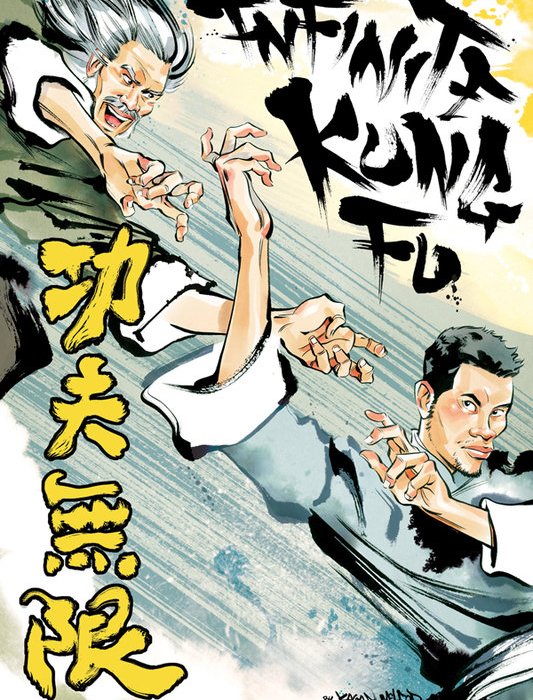


Can you tell me about the Genesis of Infinite Kung Fu as a book – how did it develop?
As soon as I discovered old school martial arts movies in college it kind of took over my artwork. Even if I had to do a school project on the anatomy of the hand I would work in a moustachioed, badly igged kung fu master to demonstrate the said hand anatomy. I started toying with story ideas around ’99 and self published the first few pages of what would become the graphic novel in 2000. I did about 200 pages on my own before teaming up with Top Shelf to finish the story.
Your love of Kung Fu/Wuxia films is obvious – how did you first get into them and what is it about them that you enjoy so much?
I’m sure it had a lot to do with Wu-Tang’s first album in ’93. After that I started buying bootleg VHS tapes through my local video store guy Colin Geddes, who wrote the forward for the book. The thrill of the hunt was a huge part of it. Finding something really obscure and weird that nobody else knew about was a blast. It’s so easy now online to get whatever you want instantly, that it’s hard to appreciate a clunky VHS tape you waited 8 weeks for with only one good ninja death.
I’ve always had a sore spot for so-bad-it’s-good material, and there’s a lot of that in martial arts movies. But for the higher quality films, obviously the choreography is impressive but I’m drawn to the ideas behind the fights. The characters are superheroes, but not mutants or aliens — just guys who became really powerful through hard work. The training is often just as exciting as the final fight.
Do you have any particular favourite films or actors?
Gordon Liu is a favourite so I was amazed to have him write a blurb for the introduction. I love his ‘monk’ movies — The 36 Chambers of Shaolin, Eight Diagram Pole Fighter. Master of the Flying Guillotine is great, and Shaolin Executioner. I also love the 6 Lone Wolf and Cub films and the whole kung fu subgenre of Black Magic horror movies, like Boxer’s Omen, Black Magic (1 and 2) and Black Magic with Buddha.
Have you ever trained in martial arts yourself?
Nope!
Gordon Liu wrote the foreword for the Infinite Kung Fu collected edition – how did that come about?
Colin Geddes, who I had mentioned above, works for the Toronto International Film Festival and is very connected to a lot of film people. At some point Gordon was in Toronto for a few screenings of some of his films, and Colin couldn’t make it to an Dim Sum with him arranged by the Hong Kong Trade Office. He graciously gave me his spot, and even being the only non-cantonese speaking gweilo in the room I still managed to snag the seat next to Mr. Liu. He’s a great guy, and I put the bug in his ear about the foreward then. Another friend, King Wei Chu of the Montreal Fantasia Festival, helped me get in touch with Gordon later on.
Although the book for the most part stays completely within the conventions of a traditional Kung Fu/Wuxia tale, you’ve also got elements of 70s blaxpoitation and of course zombies in there as well – what are the influences there?
I guess all of those subgenres fit under the “grindhouse” umbrella. Tonnes of movies from each of those genres were being made in the ’70s, so it wouldn’t be a stretch to see them packaged together as a double bill. They all have a similar vibe that I was drawn to; low budgets without much flashy special effects, funky music, real stunts. Honestly, zombies are just fun to draw so that was the reason for working them into the story. There’s so much zombie stuff out there now that I’m almost embarrassed my book has that element, but I guess it is what it is.
In keeping with the blaxpoitation elements, there’s a bit of a tip of the hat to Curtis Mayfield/Isaac Hayes style funksters in Infinite Kung Fu and nowdays, of course, the Wu Tang Clan and other hip hop artists are also associated with the Kung Fu genre – what was the soundtrack in your head as you were writing and drawing?
Right, some of Moog Joogular’s looks are based on George Clinton and Isaac Hayes. I grew up listening to ’80s and ’90s hip hop and later started to get into the music sampled by those artists. If I could recommend a few tracks to check out they might be:
1. Billy Jack by Curtis Mayfield
2. T Plays It Cool by Marvin Gaye
3. Electricty by Allen Toussaint
4. Woman of the Ghetto by Marlena Shaw
5. If I’m In Luck I Might Get Picked Up by Betty Davis
6. The Gym Fight by the Blackbyrds
Your art style is very distinctive – kind of a mixture of traditional asian ink and brush with street art/graffiti sensibilities – who or what are you main influences??
I grew up drawing from Mad magazines, copying Mort Drucker and Jack Davis art. But I do love traditional Chinese drawing and golden age illustration, which is basically anything from the late 1800s up until the ‘70s.
As an artist, how hard is it to capture the dynamic movement of martial arts in a static medium?
I found it was easier than you might think. The films have a very rhythmic quality to them, the fights anyway. Pacing kung fu moves panel to panel seems to echo that, in a way. I definitely didn’t want to try to recreate a movie in comic book form, but to suggest the flavour of the genre.
Brushes and inks seem to be your preferred medium but your pencil work in Moog’s flashback scenes was also awesome! Will we see more of this in any future work?
Sure, I’m not opposed to it. I quite like playing with line widths though and don’t do it enough (it’s easier to use the same brush for a whole drawing). If the project calls for a specific style I can try something different. I definitely wanted the flashbacks to stand apart from the main story in case things got confusing.
As both writer and artist on the title, what’s your process? Do you script it out fully beforehand or do you just have a rough outline and script it out once the art is done?
Scripting beforehand really helps me, at least chapter to chapter. I like to write without pages in mind, then go through the script and draw lines where the page breaks should be. After that I’ll figure out how many panels it will take to illustrate the page.
You’re obviously really busy with your illustration work for magazines – will we see more comics work from you in the future?
I find it hard to say no to assignments but really, all I think about is doing comics.
More Infinite Kung Fu or something else?
Something else, I hope to avoid being pigeonholed as just a kung fu guy. Details early in the spring.
Finally, how would you describe Infinite Kung Fu to someone who’d never read it before?
Martial masters working to re-achieve the ‘great balance’ after Buddhist reincarnation has gone awry, in an epic fantasy reflecting ’70s kung fu films in tone!
 The Matsignal
One comment