REVIEW: Infinite Kung Fu

infinite_kungfu_cover_sm_lg

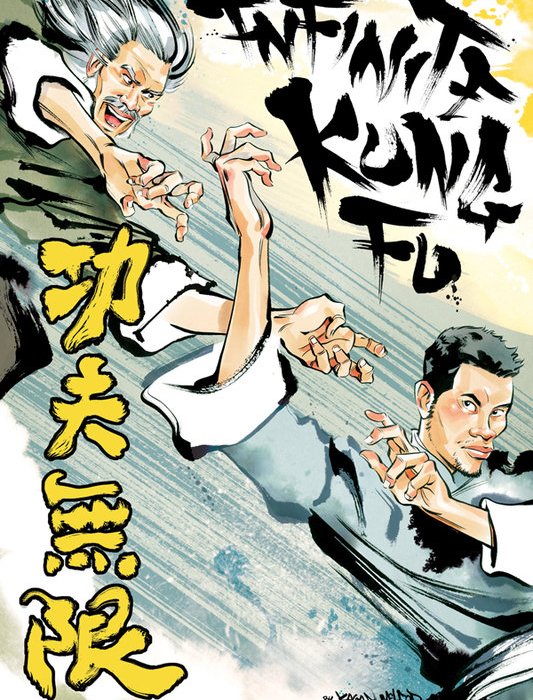
I love this book. Really, really love it. I love it so much that I don’t think I can explain how much or why without waxing long and lyrical. For those for whom long and lyrical waxing is a turn off here’s my ‘cover quote’ review:


If you took the best elements of every martial arts movie ever made, added an oh so cool splash of blaxpoitation, mixed in a hoard of zombies, and added some of the best art in comic books – you probably still wouldn’t be able to cook up a dish as scintillating to your fanboy palate as Kagen McLeod has created with “Infinite Kung Fu”.  Buy it now or tear up your comic book geek membership card forever!


Still too long? How about:


The art is visceral, kinetic, and intensely cinematic. McLeod has, perhaps more than any before, truly translated the power and beauty of the martial arts onto the drawn page. He’s a Grand Master of sequential art.


No?


Hits harder than a ‘Buddha Palm’ to the gonads!


Or for you real ADHDers:


It rules! Buy it!


Now, if you’re still reading this and not already at MK1 hitting Chris up for a copy of this fantastic tome, I’ll assume you like to get right down to the actual factual before parting with your hard earned dollars. You like to get both the nitty and the gritty before making a decision. Ok, I respect that, but don’t say I didn’t warn you!

.

I hate to admit it, but I’m old enough to remember David Carradine’s “Kung Fu” series being on the tele. Well actually, its probably more accurate to say that I have vivid recollections of seeing the oh-so-enticing ads for said series since my Mum had been to teachers college and had become totally militant in enforcing her ideas about bedtimes and not exposing my young mind to anything remotely (in her view) violent or (in my view) cool. Kung Fu came on at exactly my bedtime so the full extent of my viewing was the aforementioned trailers (usually a profound sounding snippet of conversation between the young “grasshopper” and his blind Shaolin Master, followed by some cool action scene of the adult Kwai Chang Caine kicking some bad dude in the head) and if I could manage to reeeeeeally prolong the pre-bedtime ritual putting on of pajamas and brushing of teeth – the first scene and opening credits of the show proper. This would be followed the next day by having to see and hear the endless re-enactments by my friends who all were allowed to watch the whole thing.


In my young mind, Kung Fu became the epitome of Forbidden Coolness and Bad Assery, a conclusion that was finally confirmed when my Uncle assumed baby sitting duties on the nights it was on.  Due to his less than rigid adherence to my Mum’s Commandments of TV and Bedtime I was finally able to experience the programme in its fullness. Young Matman was not disappointed.


Although it might seem a bit hokey and slow when viewed all these years later, at the time it was totally unlike anything else on tv. The idea of this mysterious fighting art from China that enabled its proponents to become unbeatable while also gaining hidden wisdom was captivating to my younger (short, skinny, and already a bit nerdy) self.


Fast forward a few years to my 12th birthday when (after years of endless pestering) my Mum finally agreed that I was old enough to watch a Bruce Lee video. It was Fist of Fury (aka the Chinese Connection) and I can remember being as enthralled by the magnetic charisma of Lee as I was amazed by the speed and dynamism of his movements. I watched it twice in a row, fell asleep, woke up and watched it twice more the next day. After that I quickly sought out “The Big Boss”, “Way of the Dragon”, “Game of Death” and “Enter the Dragon”. Having run out of Bruce Lee films to watch I exhausted the Martial Arts section of the local video shop, leading over the years to the discovery of Jackie Chan’s Kung Fu comedy and amazing stunts; the Shaw Brothers films (directed by the great Chang Cheh and Lau Kar-Leung) with exotic titles like “5 Deadly Venoms”. “36th Chamber of Shaolin”; Tsui Hark and his “Once upon a time in China” series;  to movies featuring actors like Sammo Hung, Gordon Liu, Jet Li, Donnie Yen; and to mysterious and alluring sounding techniques like the ‘Buddha Palm’, and ‘No Shadow Kick’.  The movies had implausible storylines that often relied on outrageous coincidences or launched off on weird tangents, terrible voice dubbing (and/or poorly translated subtitles), and cheap production values – but still had a magnetic pull on me.


I think the source of is that pull is that, at their core, martial arts movies are stories about people achieving the great and the unbelievable through hard work (the literal meaning of Kung Fu), discipline, and self mastery. No radio-active spiders, chemistry set accidents, or powers bestowed by powerful beings from another planet – the Kung Fu hero achieves his power by passing through great trials, making great sacrifices, and exerting great effort. They’re stories that at their heart speak to the power of human potential. You could easily argue that Batman or Daredevil are essentially Kung Fu movie men in tights (which is probably why those 2 are 2 of my my favourite super-heroes…the Kung Fu thing that is, not the tights).


This fascinating voyage through the life of Matman is mainly to point out that I was completely hardwired to either lurve or detest Infinite Kung Fu. if I, as a funny book reading, martial arts movie watching, Bruce Lee imitating fool, am not the target market for this, then it’s hard to think of who is. There have been plenty of crappy comics written/drawn by those with only a passing interest in/knowledge of the genre and if guys like me (believe it or not there are others) don’t buy it (conceptually and financially) then the book it would be hard to imagine that it would find a place in the market. Well, that’s what I thought when I first picked it up anyway. What I found is a book that has much wider appeal than to just the funny book reading, martial arts movie watching, Bruce Lee imitating fools of the world.


It’s obvious from every pencil and brush stroke on every panel of every page of Infinite Kung Fu that Kagen McLeod ‘gets’ what makes the genre work. The book is a 464 love letter to Kung Fu movies that not only references and pays tribute, but joins them in using the classic tropes (plus Moog Joogular: the coolest black man never to appear in a blaxpoitation flick, and the aforementioned zombie hoards) to tell a great story. The book is a tour de force that, perhaps more than any other comic I’ve read, captures the kinetic beauty of martial arts in sequential art (yeah, I know I already said that, but its true and worth repeating).


Although stylistically very different, the art in IKF makes me think of Jeff Smith’s work on Bone in that there’s a lot more happening that you will ever pick up on a casual flick through. Actually if you don’t give yourself some serious time to sit down and really absorb all of the detail you are robbing yourself of much of the coolness. The book is in black and white which isn’t everyone’s cup of tea but to be honest, I think that the addition of colour would actually detract from the experience – like adding colour to Frank Miller’s Sin City.


Storywise, the elements are all there. Grand Masters with mysterious powers, deceitful disciples/evil villains who use forbidden techniques, a young hero who has to overcome adversity and train hard to ultimately conquer, hot Kung Fu babes, magic, zombies, and my favourite – Moog Joogular:  the coolest black man never to appear in a blaxpoitation flick. The writing is low key and doesn’t stand out in an Alan Moore sort of way but it fits with the art to create the IKF gestalt of awesomeness.


This really is the most fun I’ve had reading a comic book in a long time (and I have a lot of fun reading comic books) and I can’t wait to see what Kagen McLeod does next (Hopefully it’s something with Moog Joogular:  the coolest black man never to appear in a blaxpoitation flick)


Recommended for:

  • Anyone who has ever enjoyed a Bruce Lee/Jackie Chan/Shaw Bros/Jet Li/Donnie Yen film.
  • Anyone who thinks that Shaft is the epitome of coolness and that ‘Sho Nuff’ was the best character in “the Last Dragon”
  • Zombie fans.
  • People who like fantastic art.
  • Ah, to hell with it – everybody! (though given the amount of entrails and detached body parts that fly across the pages, maybe not the Young and the Squeamish)


Kagan McLeod (Writer/Artist of ‘Infinite Kung Fu’) Interview


Can you tell me about the Genesis of Infinite Kung Fu as a book – how did it develop?

As soon as I discovered old school martial arts movies in college it kind of took over my artwork. Even if I had to do a school project on the anatomy of the hand I would work in a moustachioed, badly igged kung fu master to demonstrate the said hand anatomy. I started toying with story ideas around ’99 and self published the first few pages of what would become the graphic novel in 2000. I did about 200 pages on my own before teaming up with Top Shelf to finish the story.

Your love of Kung Fu/Wuxia films is obvious – how did you first get into them and what is it about them that you enjoy so much?

I’m sure it had a lot to do with Wu-Tang’s first album in ’93. After that I started buying bootleg VHS tapes through my local video store guy Colin Geddes, who wrote the forward for the book. The thrill of the hunt was a huge part of it. Finding something really obscure and weird that nobody else knew about was a blast. It’s so easy now online to get whatever you want instantly, that it’s hard to appreciate a clunky VHS tape you waited 8 weeks for with only one good ninja death.
I’ve always had a sore spot for so-bad-it’s-good material, and there’s a lot of that in martial arts movies. But for the higher quality films, obviously the choreography is impressive but I’m drawn to the ideas behind the fights. The characters are superheroes, but not mutants or aliens — just guys who became really powerful through hard work. The training is often just as exciting as the final fight.

Do you have any particular favourite films or actors?

Gordon Liu is a favourite so I was amazed to have him write a blurb for the introduction. I love his ‘monk’ movies — The 36 Chambers of Shaolin, Eight Diagram Pole Fighter. Master of the Flying Guillotine is great, and Shaolin Executioner. I also love the 6 Lone Wolf and Cub films and the whole kung fu subgenre of Black Magic horror movies, like Boxer’s Omen, Black Magic (1 and 2) and Black Magic with Buddha.

Have you ever trained in martial arts yourself?

Nope!

Gordon Liu wrote the foreword for the Infinite Kung Fu collected edition – how did that come about?

Colin Geddes, who I had mentioned above, works for the Toronto International Film Festival and is very connected to a lot of film people. At some point Gordon was in Toronto for a few screenings of some of his films, and Colin couldn’t make it to an Dim Sum with him arranged by the Hong Kong Trade Office. He graciously gave me his spot, and even being the only non-cantonese speaking gweilo in the room I still managed to snag the seat next to Mr. Liu. He’s a great guy, and I put the bug in his ear about the foreward then. Another friend, King Wei Chu of the Montreal Fantasia Festival, helped me get in touch with Gordon later on.

Although the book for the most part stays completely within the conventions of a traditional Kung Fu/Wuxia tale, you’ve also got elements of 70s blaxpoitation and of course zombies in there as well – what are the influences there?

I guess all of those subgenres fit under the “grindhouse” umbrella. Tonnes of movies from each of those genres were being made in the ’70s, so it wouldn’t be a stretch to see them packaged together as a double bill. They all have a similar vibe that I was drawn to; low budgets without much flashy special effects, funky music, real stunts. Honestly, zombies are just fun to draw so that was the reason for working them into the story. There’s so much zombie stuff out there now that I’m almost embarrassed my book has that element, but I guess it is what it is.

In keeping with the blaxpoitation elements, there’s a bit of a tip of the hat to Curtis Mayfield/Isaac Hayes style funksters in Infinite Kung Fu and nowdays, of course, the Wu Tang Clan and other hip hop artists are also associated with the Kung Fu genre – what was the soundtrack in your head as you were writing and drawing?

Right, some of Moog Joogular’s looks are based on George Clinton and Isaac Hayes. I grew up listening to ’80s and ’90s hip hop and later started to get into the music sampled by those artists. If I could recommend a few tracks to check out they might be:
1. Billy Jack by Curtis Mayfield
2. T Plays It Cool by Marvin Gaye
3. Electricty by Allen Toussaint
4. Woman of the Ghetto by Marlena Shaw
5. If I’m In Luck I Might Get Picked Up by Betty Davis
6. The Gym Fight by the Blackbyrds

Your art style is very distinctive – kind of a mixture of traditional asian ink and brush with street art/graffiti sensibilities – who or what are you main influences??

I grew up drawing from Mad magazines, copying Mort Drucker and Jack Davis art. But I do love traditional Chinese drawing and golden age illustration, which is basically anything from the late 1800s up until the ‘70s.

As an artist, how hard is it to capture the dynamic movement of martial arts in a static medium?

I found it was easier than you might think. The films have a very rhythmic quality to them, the fights anyway. Pacing kung fu moves panel to panel seems to echo that, in a way. I definitely didn’t want to try to recreate a movie in comic book form, but to suggest the flavour of the genre.

Brushes and inks seem to be your preferred medium but your pencil work in Moog’s flashback scenes was also awesome! Will we see more of this in any future work?

Sure, I’m not opposed to it. I quite like playing with line widths though and don’t do it enough (it’s easier to use the same brush for a whole drawing). If the project calls for a specific style I can try something different. I definitely wanted the flashbacks to stand apart from the main story in case things got confusing.

As both writer and artist on the title, what’s your process? Do you script it out fully beforehand or do you just have a rough outline and script it out once the art is done?

Scripting beforehand really helps me, at least chapter to chapter. I like to write without pages in mind, then go through the script and draw lines where the page breaks should be. After that I’ll figure out how many panels it will take to illustrate the page.

You’re obviously really busy with your illustration work for magazines – will we see more comics work from you in the future?

I find it hard to say no to assignments but really, all I think about is doing comics.

More Infinite Kung Fu or something else?

Something else, I hope to avoid being pigeonholed as just a kung fu guy. Details early in the spring.

Finally, how would you describe Infinite Kung Fu to someone who’d never read it before?

Martial masters working to re-achieve the ‘great balance’ after Buddhist reincarnation has gone awry, in an epic fantasy reflecting ’70s kung fu films in tone!


Rust (Comic) Review

rust

(review for www.mk1comics.co.nz website)

Rust vol 1: the Visitor in the Field (Hardcover)

MK1 Price: $45.90

Writer/Artist: Royden Lepp

Page Count: 192 pages

Self-Indulgent Walk Down Memory Lane That Will Wander All Over the Place and Eventually Connect to the Book I’m Reviewing Somehow… Honest*: (You can skip this part and go straight to the next heading if you are short of time or can’t be bothered with my rambling – I really won’t mind)

So yeah, back in the day, when I was living the Awesome (but broke) Student Life, I made it a bit Awesome-er  and less broke by working part-time as Counter Guy at your favourite comic shop (I’ve mentioned this before). Anyway, back then Friday late night shopping was still a ‘thing’ and we used to have two Counter Jockeys rostered  on to cope with the hordes of frenzied comic book junkies coming in for their weekly fix.  One of my regular Friday night co-pilots was a guy called Christian Pearce.

I used to really enjoy those Fridays because Christian is one of the nicest people on the planet and in between batting away hungry comic book zombies with the latest copy of Uncanny X-Men, we would talk about Stuff. Important Stuff. Comics, sci-fi, martial arts, music, movies, religion, life…the whole ‘42’ (‘Hitchhikers Guide to the Galaxy’ reference for those of you too young to know). Christian is an artist and would occasionally bring in examples of the latest comic he was working on – usually quirky black and white strips completely over run with robots and Stuff that ‘Splodes. Christian eventually moved away to Wellington and ditched his mild mannered Comic Shop Guy alter ego to become “Super Ultra Awesome Weta Design Dude” (which I think is a better title than “Senior Concept Artist”) at the House that Peter Built and create Awesome Artworks of Awesome Awesomeness for some small indie pictures with obscure names like King Kong, Avatar, Chronicles of Narnia, District 9, Elysium, Tintin etc.

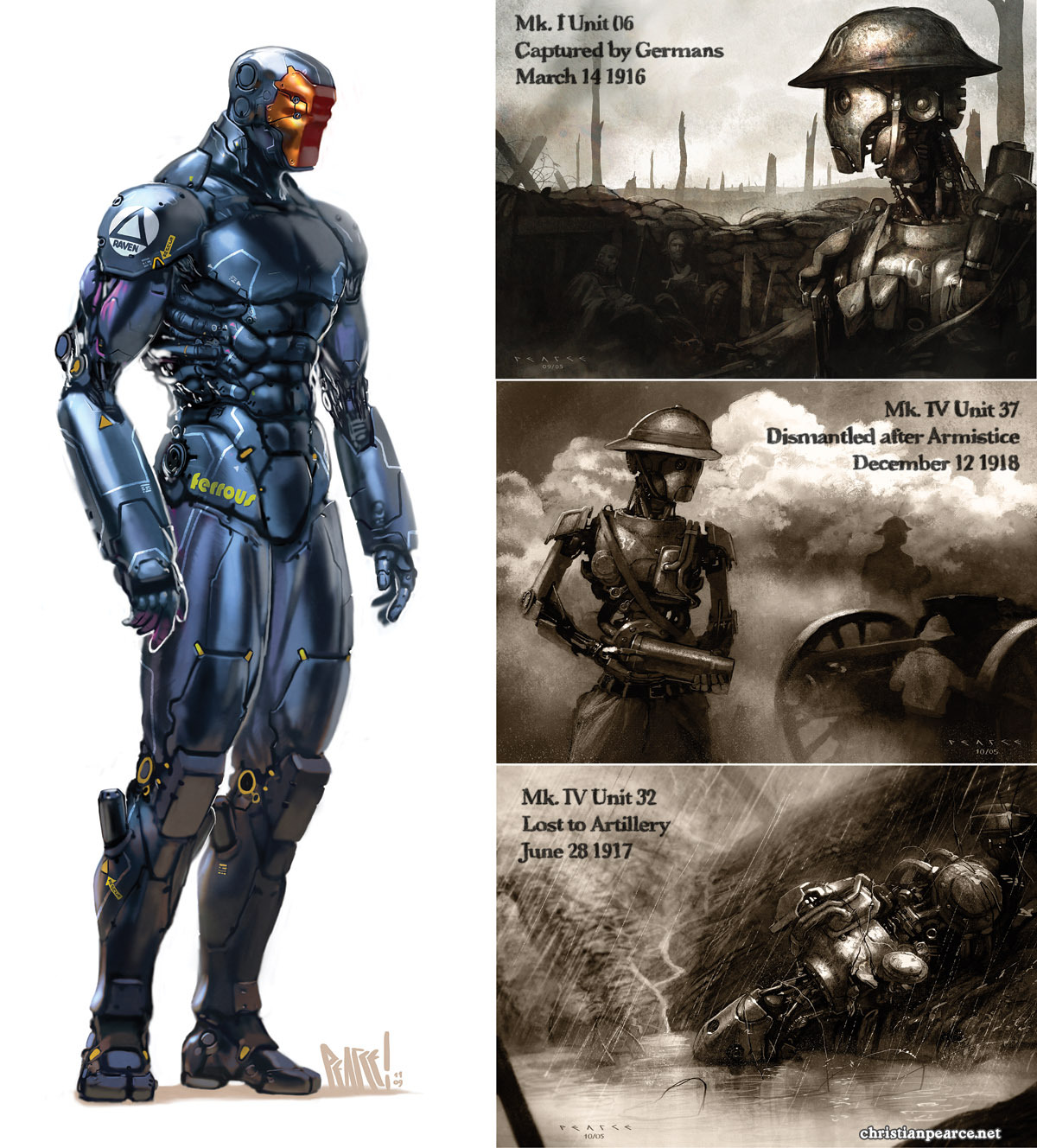
I’ve followed Christian’s work with interest over the years  – ok, more like obsessively digitally stalked him over the internet (You too can join the fun!  http://christianpearce.blogspot.co.nz/), which brings us (“Finally” you cry!) to the nexus. Given that this review is supposed to be about Royden Lepp’s fantabulously great comic book ‘Rust’, why am I going on about the equally fantabulously great (but apparently unrelated) Christian Pearce? Well, here it is: Christian has done a ton ‘o cool pictures over the years (including the cover of the latest issue of Faction – on MK1 shelves right now)but there was a series of them that featured robots in a WW1 setting that I have always loved in particular (http://payload16.cargocollective.com/1/5/190566/2629381/WW1Bot3PEARCE_1200.jpg). They’re images I’ve come back to many times and always wanted to know more about the parallel world that they inhabit. To my sequential art obsessed brain they have always looked like panels lifted from a comic and I’ve instinctively reached for the ‘before’ and ‘after’ panels that would give me the story behind them.

Having had a Great Grandfather (who was still around when I was a kid) who served in WW1 and a Grandfather who served in WW2, those periods have always been a source of great fascination for me personally. Neither Granddad or ‘Old Granddad’ spoke about their experiences very often, but there were occasional mentions and behaviours that made ‘the War’ a constant and mysterious presence that I was always aware of when I was with them.  This (plus a steady diet of my uncle’s Commando comics when I was a wee fella) means that I’m hardwired to be a sucker for a well told story in those settings.

The Review (No, really)!

Every review I’ve seen for Rust references “the Rocketeer” and I get that. It’s an ‘all ages’ story set post-war and has a dude with a jet pack. For me though, the first panel I saw that showed WW2 looking soldiers fighting robots took me straight back to Christian’s pictures. I’m not suggesting that there’s been any influence from or awareness of that work at all – just a similar high concept and one that I like very much.

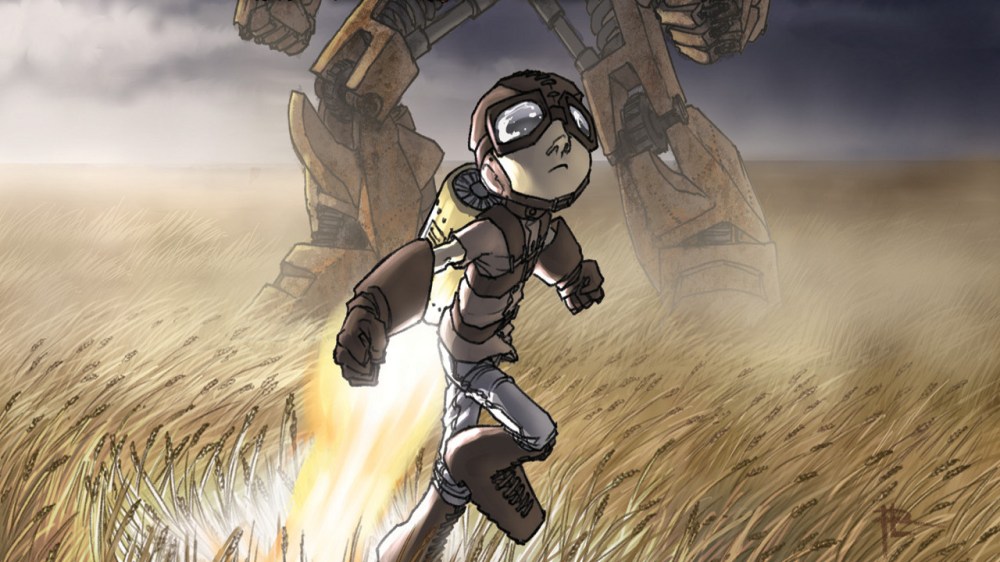
Vol 1 of Rust is essentially the tale of a jet packed mysterious stranger (Jet Jones) who literally crashes into the life of Roman Taylor, a young man struggling in the absence of his father to keep his family and their farm going in the aftermath of the aforementioned robot war. Action and adventure ensue. And there’s robots. And did I mention the Jet Pack?

As I’ve established over way too many words already (sorry Chris!…again) I am waaay pre-disposed to like the concept of this book, but a good concept alone does not turn 192 pages. Luckily Royden Lepp sure knows how to tell a story and I was ready for Vol. 2 the moment I reached the 192nd!

There’s action aplenty and a battle between Jet Jones, Roman, and a decommissioned Warbot in particular takes up a significant chunk of the book.  This could be boring, but in Lepp’s capable hands the panels and pages fly by with perfect pacing. I’m a sucker for ‘cinematic’ storytelling in comic form and the name that I usually toss out as my high water mark for that is Jeff Smith but after reading this book I might have to change that name to Royden Lepp. It may be because of his background in animation, but reading Rust is like viewing storyboards for a blockbuster action film (and a great one at that).  The flow from panel to panel is great, the action is well staged, and the art communicates the movement and impact of the battle in an exciting and engaging way. Someone obviously agrees because 20th Century Fox have bought the rights and a live action film directed by  Joe Cornish (Adventures of Tintin, Hot Fuzz) is currently in production (can’t wait!).

So it looks great.  Exciting action, cool robots, jet packs, expressive faces, moody sepia colour palate that perfectly fits the style and time period of the story – all present and accounted for. But beyond that, Rust is a book that has a lot of emotional depth and resonance. Roman’s quiet resignation about his lot in life – barely keeping his family and farm together, but determined to do the best he can – is shown through his painstakingly typed letters to his absent (Missing? Dead? ) Father.  It’s hardly a new storytelling device but it’s used very effectively here as a window into what Roman is thinking and feeling. You really get the sense of the hole in Roman’s life where his Father should be and his constant awareness of it. The letters aren’t overused though; Lepp gets just as much mileage out of a well-drawn/placed facial expression when it comes to revealing character (something I always consider a litmus test for effective comic storytelling).

I also like the way that the war is treated. The impact that it’s had on Roman’s world is huge and obvious (decommissioned war bots working on farms and absent fathers are hardly things that you’d expect to go unnoticed), but he and most of those around him have little knowledge of the details of what actually transpired – and those that do know are reluctant to share (another point of connection with my wandering preamble, though in Roman’s world there the government appears to be actively working to ensure that those events remain shrouded in mystery).    Fantastic things like Robot Wars are awesome but having characters that react in very ‘real’ ways to those events makes for compelling storytelling (and Rust is very compelling, indeed).

There are other mysteries in the book that slowly unfold (not too slowly, mind), and though not resolved in this volume, you get the sense Lepp  will reveal all in time (as opposed to the ‘Lost’ method of just making it up as you go along and writing yourself into a corner – though I do still like me some ‘Lost’!).  Jet Jones, in particular has a Very Big Secret and I’m intrigued and very keen to see how it plays out.

Finally, Just a quick word about the production values. If Archaia have ever put a book out that is not a complete and utter  thing of beauty, I’ve yet to see it. Rust comes in a super high quality hard bound format with paper stock so thick I had to keep double checking the page numbers to make sure I hadn’t turned two at a time (I never had).

Cool concept. Great story telling. Beautiful art. Go and get it!

Recommended for:

  • All ages
  • Fans of the Rocketeer or Iron Giant
  • People what likes robots (and really, who doesn’t?!)
  • WW1/WW2 buffs
  • Lovers of great comics (and aint we all!)

*Because, let’s face it, if you weren’t expecting this, you have obviously never read one of my reviews before (in which case – Welcome!)

Royden Lepp (Rust) Interview


rust

(interview conducted for the www.mk1comics.co.nz website)

M: Have you always been a ‘comic book guy’? How did you get into them?

R- My Dad bought me a subscription to Amazing Spiderman when I was a young boy. It came once a month, rolled up in my mailbox at the end of our long driveway in the country. I had to walk a long ways to grab the mail if I *thought* it was time to get it. Sometimes it wouldn’t arrive and I’d be really upset. That’s definitely how it started.

M: What comics are you reading and enjoying at the moment?

R- There was recently a sale on the original Sandman series. I started reading that since it was a book that had always intrigued me. It’s a great story. The most recent comic that blew my mind was an short webcomic called ‘Haunter’ by Sam Alden.

M: Who are your writing and drawing influences?

R- As a beginning writer of comics I was inspired by the work of Kazu Kibuishi, Michel Gagne, Mike Kunkel, and many others.

M: How would you describe Rust to someone who has never read it?

R- Rust is different. It doesn’t fit into the mainstream method of visual storytelling. It’s not for everyone but it’s a story that I care about very much. It’s about farm life, it’s about family, it’s about war, and it’s about robots. I’d likely describe it a little better than that but that’s my description today. 🙂

M: I’m always interested in how story ideas develop. What was the genesis of Rust? Has it stayed pretty true to your original conception or has it changed/grown over time?

R- It’s stayed pretty true, but at the same time it’s really evolved. It’s still the story I’ve always been telling but it’s become so much more too.

M: I’m also very interested in how autobiographical influences find their way into fantastical stories. According to your bio you grew up on a farm – Rust is set on a farm and Roman’s key driver seems to be to find a way to get away from it… anything there?

R-Absolutely. I was pretty young when we left the farm but I have some memories from it like a faint dream. I remember the feeling of being on a huge piece of land, but so far away from other people. ‘Neighbors’ were miles apart. Even walking from the barn to the house seemed to take forever. I never had feelings of wanting to get away from it, I was too young.

M: What were some of your influences in developing the setting? The easy association is to go, “dude with jetpack + robots + rural/post war setting = rocketeer and/or Iron Giant”… were those influences or did those elements come from somewhere else?

R– I honestly wasn’t inspired by any property in particular. I was definitely a fan of Iron Giant and Rockateer but I didn’t go into this property saying ‘I want to make a story like that’. Rust started with a few sketches of Jet Jones flying around. A friend said ‘Wow what’s this story?’. I said I didn’t have one and he said ‘You should’. That’s how it started.


M: Is there any story that cannot be made cooler by adding robots and jetpacks?

R- I think Bambi might have been silly if it had robots and Jet packs.

M: If you could code your own robot, what would you programme it to do?

R- My wife and I just had our first baby, so naturally; diapers.

M: In Rust you seem to be juxtaposing Roman and Jet’s respective relationships with their Fathers… Roman just wants his Dad back, Jet is running from his…how important are those relationships (and the differences between them) to where the story is headed?

R- It’s what the story is about, for sure. Hm. Not sure how to answer that without spoilers. Yes it’s important now in the book, it will be in the end. It’s a very important theme to me.

M: How tightly plotted is Rust – do you know exactly where things are going or are things evolving as you write/draw each volume?

R- Small things evolve and methods of telling the story evolve, but the story itself is set. It wasn’t always but it is now.

M: How many volumes do you think the story will take to complete?

R- Rust will be a four volume series.

M: What’s your process as far as writing and drawing go? Do you script it out in full first, or thumbnail the art and add the words in later?

R- The answer is Yes! 🙂 In dialogue heavy scenes I script and then thumbnail. In action heavy scenes I simply start thumbnailing. I do a bit of everything but everything starts with a thumbnail.

M: How well do Royden the writer and Royden the artist get on? Does the artist side of you determine the direction of the story based on what’s fun to draw – or as a writer do you have to you force yourself to draw things that aren’t ‘fun’ but necessary to get the story where it needs to go?


R- Great question. Royden the artist is the boss. Royden the artist shows Royden the writer a nice picture and makes him write a story that applies. Art work is such a big part of the process of comics that it *has* to be fun to draw. If it’s not fun to draw it’s not going to get done. Sure there are essential scenes that are less fun then others. But honestly I get a lot of enjoyment out some of the quietest, slowest scenes as well as the action.


M: Your action scenes are really cinematic – how much of that would you attribute to your background in animation?

R- All of it. 🙂 Deep down I just want to be a director.

M: Speaking of things ‘cinematic’ (see what I did there?)You’ve sold the rights to develop Rust as a live action film – how is that progressing? How involved are you in the development?

R- I am involved. It’s progressing great. Fox is a huge fan of the book, we have an amazing team of people that have come together, they want to see this story on the big screen in a big way and for that I am incredibly thankful and excited.

M: You are involved in computer game design, writing and drawing kids books, and comics – which medium do you find most fulfilling? (Or do they all have their own particular pay offs?).

R- Comics are the most fun. [Creating] video games is fun but it’s a huge group effort, with many outside influences. I get to do comics by myself, for myself.

M: Imagine that the Rust movie goes off like a…um…rocket, the books become bestsellers and you had the time/financial security/profile to work on any project you wanted – what would it be?

R- I would simply say; My next story. I have more stories to tell. Some in the Rust world, some not. If I had pure independence I’d tell them all.

M: Are those stories in other genres? Some of the art on your website has a definite fantasy (as opposed to the, I guess, Sci-fi flavour of Rust)…is that a genre that you’d like to explore as well? Are there others?


R- I’m not sure what genre those other stories are, they haven’t taken definite form. I really like robots. I like ’em a lot, so most of my stories will likely be science fiction.


Christian Pearce (Weta Workshop) interview

stalebotpearce_1200

(interview conducted for the www.mk1comics.co.nz website)

Many moons ago, back when Friday late night shopping was still a thing and I was still a counter jockey at our most esteemed comic book dispensary, I shared till duties with The Nicest Guy on the Planet…feller by the name ‘o Christian Pearce. As I’ve mentioned previously in some of my reviews, our Friday nights at MK1 were idled away with…I mean… were evenings of frenzied power selling (honest, Chris!), punctuated by (extremely short – honest, Chris!) profound pontification on a preponderance of subjects including comics, music, martial arts, religion, robots, and the number 42. As well as being the Nicest Guy on the Planet, Christian is also (as you’ll see) hilarious so I got to spend great nights at a great shop selling great comics to great customers in great company…and I got paid for it! (though the hourly (g)rate wasn’t).

Christian would sometimes show me his self-produced comics (of the black and white photocopied variety) mainly featuring big robots, or dinosaurs, or dinosaurs vs robots, or robot dinosaurs – pretty much awesome things drawn awesomely. I probably said something incredibly patronising like “these are cool – you should do something with them” and didn’t think too much more about it. I was super bummed when The Nicest Guy on the Planet announced he was leaving the Tron to move to Wellywood and I realised I would be losing my Friday night co-pilot but wished him well and off he went.

So anyway, Christian ended up working as a conceptual artist at a little company you might have heard of down there in Wellington called Weta Workshop. His movie credits include King Kong, Avatar, the Hobbit movies, District 9, Elysium, Chappie, Tintin, and the Thunderbirds TV series.

…still can’t believe he’d rather do that than work part time at MK1 and hang out with me on a Friday night but, you know, whatever.

I thought it would be great to catch up with Christian and talk about what he does at Weta and how he got there. Without any further rambling nostalgic interruption, let me introduce, Mr. Christian Pearce, Conceptual Designer (Weta Workshop), and the Nicest Guy on the Planet!


Have you always drawn? When did you start to think that art might be your thing?

Yip drawing almost from the get-go. When the doc slapped me I dropped my pencil. I was never very good though, I can only draw recognisable shapes and stuff now cos I’m very old and have done a lot of it. It was also a cheap way to have fun while I was unemployed.

Who were your first artistic influences and who influences you now?

Nothing’s changed much – comics, cartoons and people I know. Back then it was Wacky Races, Whizzer and Chips then 2000AD. A couple of guys in my class at school were amazing, so so so much more talented than I was. I couldn’t comprehend how they drew like that.

Now it’s the same except the comics are weird japanese ones and the school has been replaced by Weta Workshop. My workmates still give me the same sense of shame and failure as those talented kids did too

Have you had any formal art training or are you self-taught?

I did a media course at Waikato Polytech for a year. There wasn’t much about drawing in it though but there were a few things I learned that really stuck with me. I mainly went so I could get a huge student loan I could spend on burritos and drums. I always regret not doing any formal training, I still think it would be super beneficial. Learning by yourself kinda forces you to develop your own techniques and “style” I guess, for better or worse.

It took me 15 years to pay back that student loan by the way. D’oh.

Where does your love of robots and dinosaurs come from?

That comes from being a normal human being. Everyones loves that stuff! Right? Also not being very good at drawing people makes them even more appealing. No one really knows what a dinosaur or a futuristic space robot looks like so you can get away with much more.

Having grown up reading my uncle’s old commando comics I’m guessing the World War 1 and 2 stuff comes from something similar?

100%! I remember going to the supermarket with mum to get groceries and running straight to the magazine rack. They had Commando and I could read two issues before I had to help carry the bags to the car.

What other comics did you grow up reading (I’m going to take another guess and say 2000ad)?

Ha! Yeah I already admitted to that! You’d read whatever you could get though, spesh when I was real young. We were pretty isolated and there was only one book store in the town. Beano and Whizzer and Chips were my main things, odd British stuff. There was a short-lived comic called Scream that was a collection of horror stories that was a revelation. Everything changed once I discovered 200AD though, just like it did years later when my friend gave me Akira to read. Other real turning points were the original Tank Girl series, Masamune Shirow’s stuff  and Geof Darrow’s work, particularly his stuff with Frank Miller

Do you still read comics? What are you into at the moment?

Yeah I love ‘em. I love finding new weird stuff, oddly it’s often Japanese. There’s lots of quite shocking, gruesome stuff out there which still fascinates me. Gory horror stuff. Suehiro Maruo is an incredible illustrator. Junji Ito is lots of fun. Kazuo Umezu is creepily inventive. Taiyo Matsumoto is a genius. Katsuhiro Otomo is still the absolute master though, I read Akira every year. I enjoy finding new local stuff too, the Faction comic anthologies have been great for that. I’m reading Ant Sang’s Dharma Punks right now, a series I started reading when they were first happening but never finished. It’s still good too!

How did you go from self-publishing indie comic guy living in Hamilton to Super Ultra Design Dude at Weta?  (I think you should put that on your business cards – Christian Pearce: Super Ultra  Design Dude…actually maybe it should be more like Super Cool Ultra Design Dude because that’s SCUDD for short as opposed to SUDD… Missiles are cooler than soap, I think).

Missiles are cooler than soap, no question. If only we could replace warheads with shampoo though this world would be a happier, cleaner place. Less nuclear deterrents, more cleaner detergents

Man I really dunno. Very lucky. I was unemployed and took a punt moving to Wellington. My friend Greg did some illustrations for a little free magazine here called the Package and then I did some too. Doing stuff for that and a bunch of kid’s schoolbooks through Learning Media taught me how to work hard and deliver to a deadline. Greg got a job at Weta it sounded amazing, quite unbelievable. I had no idea how film making worked or what concept art was. He helped me get a job there, the first thing I worked on was Neon Genesis Evangelion, and I’ve been riding his coat tails ever since.

I reckon Conceptual Artists are like the Black Operatives of the movie world – you never know what they’ve been up to apart from the odd glimpse here and there, and most of what they do they can’t tell you about! Does it ever get frustrating that so much of what you create doesn’t get seen?

Yeah it’s kind of a drag, it doesn’t bother me so much now but it used to be pretty frustrating. Just know that every single piece of artwork I’ve done that you haven’t seen was totally AMAZING

What have been some of the highlights for you in terms of your movie work?

King Kong (1933) is the best film ever so drawing dinosaurs and monsters for Peter Jackson’s version was pretty fun. Obviously Fury Road was fantastic too…. Chappie was fun and it was awesome seeing the practical robots get built for that. He looked fantastic in that film. Godzilla was a real treat, that was really special. Although it’s not a movie I’m really enjoying Thunderbirds Are Go, always interesting new stuff to do on that show and the quick turnaround is quite refreshing.

Some of the properties you’ve worked on like Thunderbirds, Tintin, Mad Max are ones where the audience already has a very well defined sense of how the characters and world should look – is that difficult or limiting – or is there still fun to be found in creating something within those toyboxes?

Yip it can be tough but yip again there is fun to be had. You just don’t wanna stuff it up and wreck what was great about the original but then again there’s no point in making something the same as what you’ve already seen.

Your work has brought you in contact with some famous directors and movie types – do any particular people or encounters stand out? (I promise not to accuse you of being a name dropper!)

We get all kinds of people coming through Weta, it’s a pretty interesting place to visit if you’re famous enough to be let in the door haha. Dillinger Escape Plan came through the workshop today, they’re pretty rad!

…Name Dropper!

How does it work – do you generally show your concepts to the director…um…directly, or do they get filtered through an Art Director first?

We usually work directly with the directors. We are directly directed by directors. We’ll get specific notes about concepts we’ve submitted, either through emails or skype calls or in person if we’re lucky enough to have ’em near by, and will incorporate their notes in to the next round of designs. Often they’ll have very specific feedback, other times they just want you go out there and explore a buncha options.

Have the directors you’ve worked with generally had a strong sense of how things should look and try to get you to work within that space or do they look to you guys to spitball new ideas until they find something they like?

It varies a lot. Some of ‘em know exactly what they want and they basically just wait for you to illustrate it just right, others have very vague descriptions and want you to go and muck about with a bunch of ideas. Hopefully something you’ve done will give them a spark or an inspiration that you can develop with them

Could you describe an average work day in the life of Christian Pearce?

Wake up fall out of bed, drag a comb across my head. Find my way downstairs and drink a cup, I’ll look up and notice I am late. I pick one of my many rusty half-restored bicycles and ride to work. I’ll make a black coffee and chat with Salma Hayek, spend 10 hours doing perfect illustrations that never have any perspective problems and have a 100% success rate with every concept I pitch to a director, get a pay raise every day and then bench press 250kg easy as.

Kidding! I never brush my hair.

What’s the best thing about your job?

The delicious irony of getting in trouble if you are caught NOT doodling spaceships and robots

What are you working on at the moment (that you’re allowed to talk about)?

This amazing new film directed by *** ****** is looking ****ing fantastic, it’s about a **** who goes to ***** and *****s a whole bunch of ****. Incredibly, ****** ******** turns up at the end, ******s all the *** ******* then *******s out the goddamn *******! Haha it’s gonna blow your mind!

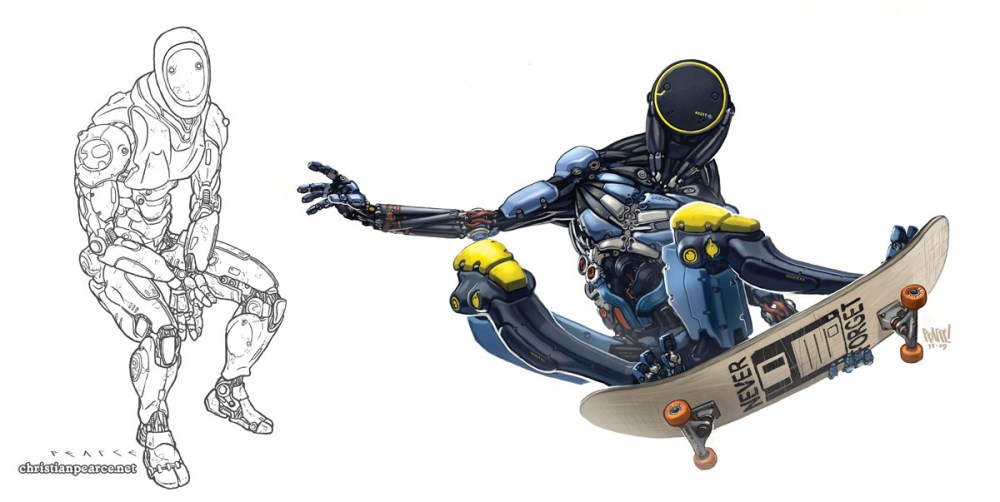
A lot of your own work that I’ve seen (e.g. Roboxer; the WW1 robots; your robot skater dude; and various monstrous city invasions) always makes me want to know more about who the characters are or what’s going on – do you usually have a story attached your pictures or are they just conceived as single images?

Huh! Cheers man, I kinda do have an idea of the worlds my more fully rendered stuff exists in. Most of my stuff is just totally mindless doodles though, goofing around with shapes and ideas

It’s been cool to see you do short comic stories in [New Zealand Comic Anthology] Faction and the Giant Killer Robots comic you did with Paul Tobin for Comicon (http://issuu.com/giantkillerrobots/docs/gkr_comic)  – are you working on anything else of your own at the moment?

Thanks! The GKR stuff has been really fun and I think we’ll be getting stuck into that stuff again really soon, flesh out the comic a bit more.

For my own stuff – most of my free time is going into these little plane sketches I’m working towards doing an exhibition of. I’m working on a videogame based around them too, all hand drawn sprite based stuff. It’s a heckuva lot of work but I’m quite excited about it, should have something to show of it really soon.

You play drums in a piece punk band with Greg Broadmore – do you like to hit things?

Greg makes you want to hit things, fortunately the drums usually get in the way. I blimmin love the drums to be honest. I want to be able to focus on learning to play better, I’ve been playing for nearly 30 years now and have realised how lazy and sloppy I am with my technique. I feel like I should start again, try and unlearn everything and actually get some lessons. It’s a tough instrument to practice though, the most anti-social and neighbourhood-enemy-making contraption in all musicdom

What do you remember about your time as a counter jockey at MK1?

I remember never figuring out how to use that consarned gosh-danged dad-blamed cash register! haha I remember you and Chris wondering how I could even dress myself. It was just too advanced for me.

I’d always be struggling to find new excuses to get one of you guys to ring up the sales, I think I even invented RSI as a reason to not push those buttons. That one really caught on, now everyone’s got it! My one true contribution and enduring legacy to the modern workplace.

I remember finding so many rad new comics and artists in my time working with you guys though, good memories!

Check out Christian’s work in the Faction Comics Anthology available in store or here on the website (http://store.mk1.co.nz/faction-presents-high-water.html)

If you prefer 0101010 to pigment on dead trees you can check out his spot de blog here: http://christianpearce.blogspot.co.nz/

or his gallery of virtual visionary virtuosity here:

http://cargocollective.com/christianpearce


Greg Broadmore (Weta Workshop) interview


(interview conducted for the www.mk1comics.co.nz website)

My first exposure to the fantastically fantastical work of Mr Greg Broadmore came from Weta Workshop’s “World of King Kong” book  – which I mainly bought because my old workmate Christian (Pearce – see interview with him here: link) had some pictures in it. As I perused this folio of fine illustrations, certain pictures stood out and I kept noticing this “broadmore” signature on them. Fast forward a while and I’m at the Armageddon expo in Auckland. It’s towards the end of the day and the Weta booth that I’ve been meaning to check out all day but has been crowded finally looks pretty clear. I go over to check out some completely outrageously rad ray gun props (honestly the coolest thing that you never knew that you always wanted) they are selling there and find out that the dude manning the stand is the very same Broadmore (and creator of said outrageously rad ray guns).

 Greg recognises my t-shirt (from my old ‘brawla’ clothing line and featuring a design Christian had let us use), I let him know that it was my business which lead onto an in depth discussion of our shared love for fight sports. Anyway, an hour or two later and he’s sold me a copy of his book: “Doctor Grordbort’s Contrapulatronic Dingus Directory”, and I’ve somehow got him to agree to let us use a couple of his designs on our shirts). Never met me before, doesn’t know me from any of the thousands of others who had passed through that day, no contracts or fuss. Just a “sure, man!”

 Greg’s pulp sci-fi world of Doctor Grordbort and his Infallible Aether Oscillators (that’s outrageously rad rayguns to the uninitiated) has caught many imaginations and long outlasted my business venture but what I learned from that exchange (that I’m sure Greg has completely forgotten) and my subsequent dealings with this Doyen of Dodgy Designs is that he is a super cool dude who draws and designs super cool things and is totally super cool about it.

 So, thus ending this latest iteration of my endlessly rambling preambling, may I introduce to you Mr Greg Broadmore: Conceptual Designer on movies such as King Kong, Avatar, District 9, Chappie, Adventures of Tintin, and Godzilla; creator of outrageously rad rayguns (and the visceral and endlessly inventive pulp sci-fi world they inhabit); muso, and Computational Game Designer of The Thing That is the Coolest Thing in the History of Cool Things But He Can’t Tell You About Without Killing You Afterwards (But It Really Is Cool).

 When did first you start to think that art might be your “thing”?

I can remember drawing being my ‘thing’ since I was maybe 4 or 5 years old. It was all I ever did – draw pictures of dinosaurs and tanks.

What comics did you read as a kid (based on your work I’m going to take a fairly obvious stab and guess 2000ad? Commando comics? What else?)

Yes and yes! 2000AD, Commando comics, MAD magazine for sure.

I think the very first comics I read were Batman and Spiderman along with some Archie and Casper the Friendly Ghost.

Later I found Starlog, then 2000AD and Judge Dredd I knew I’d found something for me. Those stories were darker, funnier than the US comics I’d read, and satirical in their own way, plus they were sci-fi. I loved that. I never really connected with the super-hero thing.

My Grandad worked at a paper mill and would bring me home comics that were going to be recycled, and reams of cardboard and paper to draw on. So I was lucky and got to see a ton of different stuff.

I also remember seeing Captain Sunshine, and when I found out it was made in New Zealand that flipped me out. Everything I’d ever seen was made overseas.

I read comics for years as a kid before I realised that someone actually wrote and drew the books I was reading and that the reason a lot of my favourite books were my favourite books was because they were drawn or written by the same guy. I don’t think I twigged to that until I read 2000ad and noticed that it had the “art droids” names on each story and I then realised that the Judge Dredd stories that had Brian Bolland’s name on them looked better to me than some of the others. At what point did you become aware of particular artists and their styles and start trying to emulate them?

I think I realised that very early, cos I drew myself.

I remember looking at Commando comics and they never credited the artists (that I noticed), but I definitely had favourite artists – one in particular. So I would search for his comics and get them before I got others. I got into Mad magazine very early too, and that had such a diverse group of artists – the styles were so different. Having Sergio Aragones next to Mort Drucker or Don Martin… it was so eclectic, from super cartoony to really hyper-realistic caricature.

I didn’t try to emulate anyone though. I knew an artist’s style made them stand out, so I tried not to copy anyone. I did go through an ‘obsessed with Simon Bisley’ phase though. And I know that rubbed off on me. Hard for it not to, he changed everything.

What do you read now?

I am re-reading a lot of Judge Dredd actually, along with Charlie’s War, which I never read as a kid.

 You spent some time living in Hamilton – do you have any memories of MK1 from that time?

Oh yeah – I loved living in Hamilton. To be fair, it was a munter-town in so many ways, but there’s a special place in my heart for it. I met a lot of mates there, like Christian Pearce – we played in a punk rock band, Ghidrah while we lived there, and made comics. Now we work together at Weta Workshop making movies and games.

Mark One was one of Hamilton’s saving graces – without that comic shop it would have been a bleak place for me.

 You’ve known Christian for years, work with him and you both play in Ghidoragh – is he really the Nicest Guy on the Planet or does he have a hidden dark side?

He is nice to your face, but behind closed doors he is a violent racist and homophobe who hates women. And dogs. Especially dogs. And the elderly – he complains bitterly about the elderly.

Nah, I’m joking. He loves dogs.

Obviously you’ve left your mark on the ‘Tron with your Riff Raff statue – how did that come about?

I think I’d been at Weta Workshop for a year or so, and Mark Servian got in touch with Richard Taylor about the prospect of putting up a statue to celebrate this iconic creative, Richard O’Brien who’d spent formative years in Hamilton, but the fact wasn’t embraced.

I think for Mark it was a chance to help give due credit to someone and something that was a hidden part of Hamilton’s history, but that was so much the opposite of what Hamilton normally represented. Me, I jumped at the chance to help put a gay and transsexual icon in a town that often stands for macho retardation. I was proud as f**k.

You also did the awesome tripod statue in Courtney Place. I did a few month’s work in Wellington a while back and my (then) 3 year old decided that it was the Iron Giant and that we had to drive past it every time we went anywhere in the car (regardless of whether it was on route or not). If he wasn’t looking and missed it we had to drive around again or there would be tears. How does it feel to have created something that’s such an iconic local landmark in the place you live?

That is my favourite story about the Tripod ever! I love that – Your son is my new best friend.

I’m really proud of that beast – I was super surprised that it got picked to be honest.  We designed more than hundred statue concepts, and took about 10 of them to a very high level, with mock-ups, sculptural maquettes etc… I was working on that one, along with two of Richard’s ideas. I assumed those ideas would be the ones, so I was stunned when the tripod was selected. Christian actually worked on that one too – he did heaps of the presentational work, showing it in situ etc…

When we started building it, I actually felt horribly guilty. Like I said, I thought some of the other ideas would go through, and I actually offered Richard my small amount of savings at the time to help offset the costs of making it. Luckily Richard said no.

How did you end up working at Weta?

I had moved down to Wellington, after getting fired from the dole in Hamilton (I was on the dole for about 7 years), and after selling everything I owned to pay rent, I got work in a videogame store and was trying to get work doing illustration.

I knew Peter’s Lord of the Rings was coming, but when it finally came out, I was just floored by it. I was excited for it beforehand, but it just blew me away. I had no idea that something so epic could be made in New Zealand. I thought, ‘Hell, I draw monsters and stuff, I love Dungeons & Dragons… I should work there!” I knew this was a ridiculous thought though, cos I had absolutely no experience in film and barely understood what concept design was. But I sent in a folio and heard back from Richard Taylor a few weeks later. I was giddy about that. I also felt like a total fraud.

He invited me in, showed me around the workshop, which was a wonderland of exciting stuff. Amazing artistry everywhere. Monsters in corners, silicon bodies lying in a corner, swords and axes and armour on every wall… and people beavering away making incredible things.

I had the gumption to ask “So, when do I start? He chuckled at that, but a few weeks after that I had a job. A two week trial actually.That was in 2002, and I’ve been here ever since. Still on my trial I guess.

Which movies have you most enjoyed working on and why?

Kong was my first big film, and as a dinosaur nut, that made me very happy. It was hard work though.

District 9 has to be my favourite experience though. The subject matter, the fact that we started with a blank slate (it came of the back of Halo in which we were basically re-designing an existing world, which is not much fun for me), and the fact that I was working with a director who I felt a great connection with, and who shares a lot of the same inspirations.

 Are you still involved in movie work or do your other projects take up most of your time now?

Nope. I almost never do film work anymore. I was just looking at some Mad Max: Fury Road work I did, and realised the art was dated 2009…. that might have been one of the last films I dabbled in, and Chappie.

My real love has always been videogames, and I’m now directing a videogame with a company called Magic Leap. It’s based on my Dr. Grordbort’s sci-fi world, and we’re building it with a new team based at Weta Workshop.

The first time I saw one of the Dr. Grordborts ray guns, I (old dude that I am) straight away thought back to the old Flash Gordon black and white serials they used to show on Sunday arvos on TV1 back in the day. I would have thought that you’d be too young to remember those but is that the type of old school pulp sci-fi vibe you were going for? The whole pulp thing seem to be a bit of forgotten era/genre ( well there is Steampunk, but that seems to me to be a pretty small corner of something previously much larger)– how did a young fella like yourself become aware of that type of stuff? What is it about that period/type of speculative fiction that appeals to you?

 I might be older than you think… I grew up on those old serials. Our first TV was black and white, and so all those old shows – the sci-fi serials like Flash Gordon, adventure serials like Tarzan, and old films of the 30’s and 40’s like King Kong, even though it was old by the time I saw it, it made no difference to me. I thought it was all just awesome adventure goodness… So I was infatuated by boilerplate rockets, weird rayguns and art-deco inspired scifi worlds since I was maybe 5 or 6.

I illustrated the rayguns as my own little personal homage to that era of science fiction, intending to just put them on my wall, but I showed them to Richard Taylor one day during the production of our version of King Kong, and he loved them. We were making them as collectibles in short order. Took em’ to Comic Con in San Diego, got a great response, and just sorta dived into it.

 Did you start with the rayguns (or rather “Infallible Aether Oscillators”) and then imagine and build the world around them or were they always conceived as part of the wider world (or rather, universe) of Lord Cockswain?

The rayguns came first,  then I needed an inventor, Dr. Grordbort, then someone to use them, Lord Cockswain, and the world of Dr. G grew layer by layer around that.

Is “Dr. Grordbort” a riff on your own name? His picture is always blurred out, would he look something like you if it wasn’t?

It is… but it’s not entirely intentional. I used to sign some of my artwork with stupid version of my name, like Grordbort, Brorgblort, Broadmoron… I especially used those if I thought the drawing was crap.

When I needed a name for the inventor of the rayguns, that silly throwaway collection of letters was just sitting there, so I used it. I didn’t think it would be connected with my own name, which just goes to show how much of a moron I actually am.

I hope we are nothing alike. Both of the main characters in Dr.G are no good – I know that’s weird, but it just made sense to me. I had no interest in writing about heroic characters. Dr. G is a functioning sociopath – someone whose only goal is wealth, and sees people as ants in an anthill. Give them what they need to destroy each other, as long as he profits.

Lord Cockswain is an aristocratic buffoon. A racist, a misogynist, a relic of his era. Someone born into privilege who has only ever seen themselves at the top of the pile. But his stupidity is his defense – he’s a mental infant on one hand – completely naive and oblivious to nuance. So he’s not necessarily mean-spirited. Just a massively self-infatuated idiot. I might have more in common with him….

How come there are not adverts for beard maintenance products in the Dr Grordbort’s catalogue?

Ha! Are you referring to the fact that I also have a beard? It never occurred to me to add beard related stuff. I only have a beard cos I hate shaving. I don’t really like beards per say – I’m just lazy in the mornings.

Someone asked me a while ago what “Victory” was about and the best I could come up with was, “Victorian man behaving badlywith raygunsin space.”

That’s a pretty good appraisal, although it’s probably ‘Edwardian men’.

The first book, Dr. Grordbort’s Contrapulatronic Dingus Directory was a Sears and Roebucks style catalogue of wild and wacky inventions, with the repeated message they they’re all a waste of money, or potentially dangerous or life threatening. It was a kind of commentary of the bullshit we buy – half the inventions in that book are kind of the ‘Ab-Flex’ of their day.

Victory was intended to be more of a ‘Boy’s Own’ adventure annual, and I styled it like that. But the statement I crafted it with, was ‘Propaganda for Children’. That guiding concept was present in my mind as I put the whole thing together. By that, I mean that it was Dr. Grordbort, selling a book to kids, that glorified war, glorified weapons, and glorified earth subjugating and colonising the solar system. That was his (barely) hidden goal if you like.

Triumph was my chance to focus on Lord Cockswain, as I found writing and illustrating him to be the most fun. Titan publishing has combined all three books, along with a whole book’s worth of new content into the latest release, ‘Onslaught: Excessive Space Violence for Girls & Boys’

How many times have you been asked if your ray guns actually work?

 I have had sooooo much grief travelling the world with them. I have an exhibition based on the Dr. G world that’s travelled Europe and China, and I would often take various rayguns on trips with me.

The worst incident was being dragged off a plane onto the Hong Kong tarmac by armed police, in full SWAT gear, MP5’s and all, and being made to open the wooden case containing the Unnatural Selector Ray-Blunderbuss. They made me open it, and stood over my shoulder, submachine guns in hand, watching me like hawks, and as it opened and they saw the raygun, they pushed me away so I couldn’t touch it (assuming I might disintegrate them I guess). I was explaining the whole time that it was a piece of art, and not a real weapon, but it’s tricky when you’re trying to not say the word ‘gun’.

That was scary in retrospect – they were dead serious, as you’d expect. But at the time I thought it was great fun. My only worry was that I’d be taken off the flight and get stranded. Stranded in Hong Kong wouldn’t be so bad though.

How did the “Onward to Venus” board game come about?

Martin Wallace of Treefrog games got in touch with me when he moved here from the UK. He’s an amazing game designer and has made a slew of award winning board games, and notably games based on Terry Pratchett’s work, Neill Gaiman’s work etc..

He sent us a white box version of the game, and wanted to to license the Dr. G IP. Making a board game is something I’ve wanted to do with Dr.G for many years (as well as tabletop games, Role-playing games etc.) so it was a no-brainer for me. It came out really well – really beautifully presented.

 Between that and the short film that the guys at Media Design School did (https://www.youtube.com/watch?v=OSwNFVjCquU ), it must feel good to know that you’ve created a world that resonates enough with other creators enough that they want to play around in it

Yes, absolutely. It’s really fun to have other people come in and interpret the Dr. Grordbort’s universe in their own way. It is a very open ended universe, and I’ve only scratched the surface of it. It’s a fun playground for sure.

What can you tell me about your involvement with the super-secret “Magic Leap” (without killing me afterwards) – Have you left the world of moving pictures to fulfil a lifelong ambition to design bouncy castles?

Ha ha! Yep, Magic Leap is purposefully ambiguous for sure – I’m very glad it could be interpreted that we’re making bouncy castles! I’ve been working with Magic Leap for coming up 4 years now, and it’s a lot of fun. We’re developing a game for their new system based on the Dr.Grordbort’s world and I cannot say much other than it’s gonna blow minds.

You play guitar in Ghidoragh – how would you describe your music?

I actually play bass and vocals in Ghidoragh, which me, Christian Pearce and Brian Holloway started in Hamilton back in 94 or so. Back then I described it as a rocket powered dragster going a million miles per hour down the strip with the wheels wobbling and parts falling off, heading for certain disaster.

We’re the same now but we go even faster and the wheels are even looser. (https://ghidoragh.bandcamp.com/ )

 How long have you been playing in bands?

 Hmmm, since maybe 89 or so? I started then borrowing a bass and playing in super-shitty but super fun punk and grindcore bands. Playing music (or noise that approximates music) was my real passion from when I was about 18 until my late 30’s. I all but lost interest in art during that time – it was very much something on the side that i dabbled in. Before Ghidoragh I had a band called Nihil that I formed in Auckland and brought down to Hamilton – even won a battle of the bands!

I got back into art when I moved to Wellington, which was partially inspired by meeting Martin Emond and Simon Morse down here, and realising you could make a career in comics.

I’m getting back into music in a serious way now – I play with Ghidoragh and have another band with Christian and Nathan from Beastwars called Wyrm Spyrm, which is super slow and sludgey.

I imagine being an artist would be a pretty solitary sort of thing where the work is produced byy ourself and the feedback and response to it could come quite a while after the creation was finished, whereas playing in a band is much more collaborative and the response is much more immediatedo they scratch different creative itches for you or is art just art for you regardless of the medium?

 Yeah, they totally do. Illustrating can be a much more solitary thing for sure, but design at a place like Weta Workshop is more collaborative, and you chat about ideas with other designers often. But nothing beats music for that. Playing in a band is all communication – it’s listening and reacting, continuously…And yeah, they do scratch different itches for sure.

I asked Christian what the best part about his job is and his response was, “The delicious irony of getting in trouble if you are caught NOT doodling spaceships and robots.” That got me wondering what you guys do if you were procrastinating work (not that you ever would, of course)? Do you have cunningly disguised maths books stashed under your drawing tables or something?

 Yes, math books. Full of wonderful maths equations. And porn.

What is the best part of your job?

The answer to this is incredibly corny – it’s imagining things that don’t exist; weird and wonderful things, characters, places, stories… then seeing them realised, seeing them come alive on screen or as props you can hold, sets you can stand within or virtual worlds you can explore. It doesn’t get much better than that. Other than porn of course.

Greg’s books “Victory”, “Triumph”, and “Onslaught” are all available right here at MK1 http://store.mk1.co.nz/doctor-grordbort-presents-victory-hardcover.html

http://store.mk1.co.nz/doctor-grordbort-presents-triumph-hardcover.html

http://store.mk1.co.nz/doctor-grordbort-onslaught-triumph-hardcover.html


Check out Greg’s blog here for visual stimulation and bloggery: http://gregbroadmore.blogspot.co.nz/

…and the Dr Grordbort’s site here to find out more about his finely crafted instruments of Death and Destruction that don’t actually deliver Death and Destruction (well, I suppose they could deliver Death if you hit someone on the head with one) but totally look like they could/should: http://drgrordborts.com/dr-grordbort-s-infallible-aether-oscillators-where-science-meets-violence/


sentinel_eml